


Business & corporate websites
Explain your services, establish credibility and help visitors enquire. We plan service pages, team profiles, locations and navigation around the information your buyers need.
Design / Development / Growth
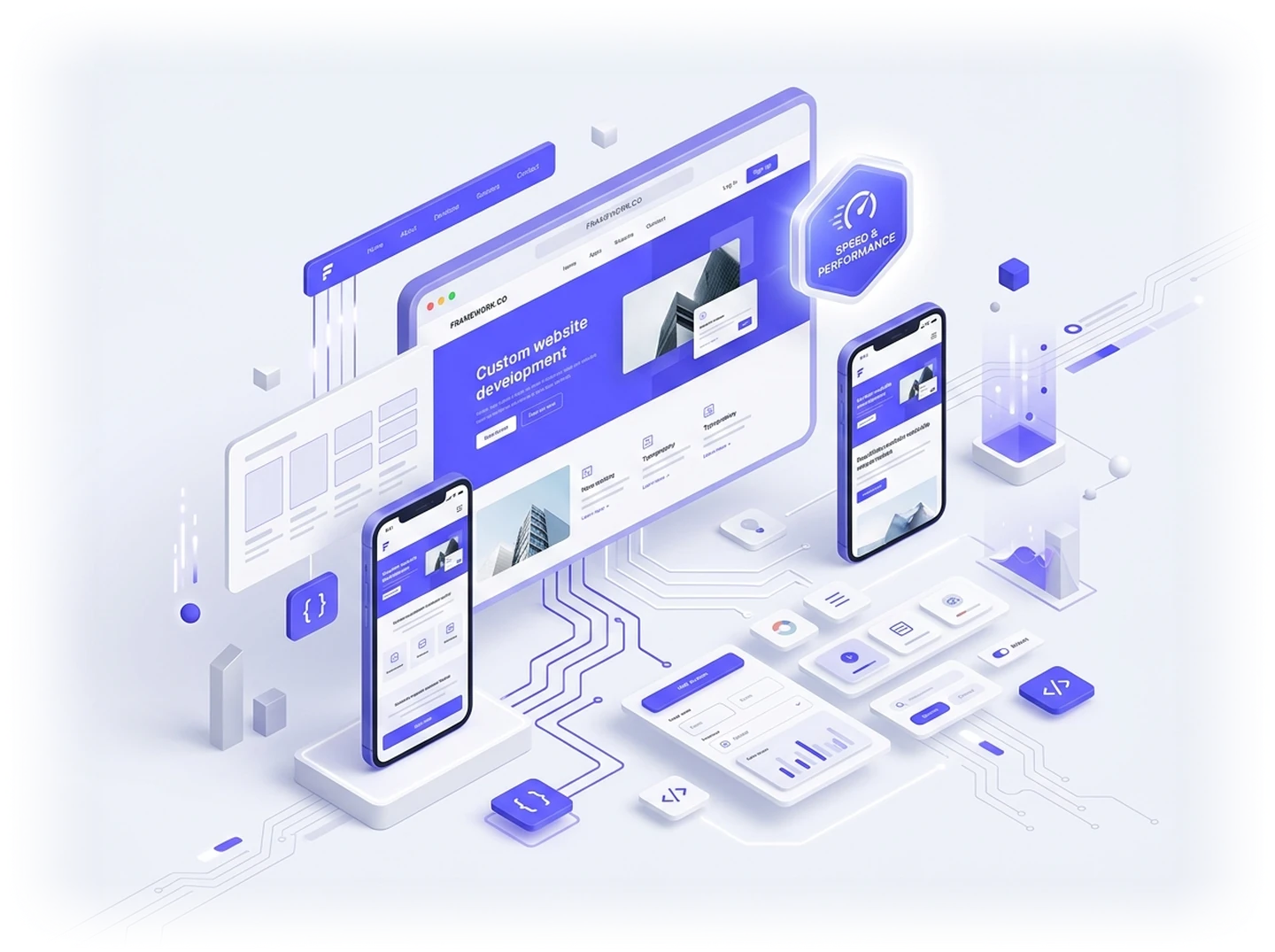
Turn your website into a clear path from first visit to enquiry. We bring strategy, design, development and technical SEO together to build responsive websites your customers can use and your team can manage.
Strategy to launch. One connected team.
01 / The right website for the job
Start with the job your website needs to do. A new brand, a growing content library and a customer portal each need a different structure, scope and publishing workflow.
Explain your services, establish credibility and help visitors enquire. We plan service pages, team profiles, locations and navigation around the information your buyers need.
Connect an ad or email to a focused page with a relevant offer, useful proof and a clear action. Forms and conversion events are scoped alongside the design.
Improve an existing site with a content inventory, page mapping and a staged launch. Preserve useful URLs where possible and plan redirects before changing the structure.
Give editors reusable page sections, structured content and appropriate permissions. Plan previews, publishing workflows and training around the people maintaining the site.
Plan language-specific routes, navigation and content relationships from the start. Translation ownership, regional differences and ongoing updates are part of the brief.
Create authenticated experiences for customers or internal teams. We scope user roles, data flows and integrations separately from the public marketing pages.
02 / More than the pages you see
Good website development connects content, interaction and the systems behind them. We define these requirements before the build, so the site is ready for everyday use.
One connected experience
Useful pages that help people find you.
Clear content that helps them choose.
A simple path to enquire, book or buy.
CMS · Integrations · Measurement
Readable layouts, keyboard navigation, visible focus states and clearly labelled forms. Test key journeys across agreed browsers and screen sizes, with an accessibility target defined in scope.
Set image and script budgets early. Use responsive media, deliberate font loading and appropriate rendering, then review important templates and real-user performance when data is available.
Clear headings, descriptive page titles, crawlable links, canonical URLs and XML sitemaps. Add relevant structured data that matches visible content and review indexing settings at launch.
Define what happens after an enquiry: validation, delivery, acknowledgement and routing. Track meaningful actions with an agreed consent approach, and test both success and failure paths.
Our migration planning follows Google’s guidance on site moves and redirects.
Website features
A clear view of the capabilities we can build into your website. We agree the right combination, integrations and ongoing support in your project scope.
 01
01Layouts, navigation and touch targets that adapt naturally to phones, tablets and desktops.
 02
02Responsive images, efficient fonts and controlled scripts, with performance checks on key templates.
 03
03Page titles, canonical URLs, crawlable links, sitemaps and indexing controls planned into the build.
 04
04Keyboard navigation, visible focus, readable contrast and labelled forms, aligned to agreed accessibility goals.
 05
05Reusable content sections and editor-friendly fields so your team can publish everyday updates.
 06
06Clear validation, confirmations and routing to help the right person respond to each request.
 07
07Measure meaningful actions such as enquiries and bookings with a defined consent approach.
 08
08Connect agreed sales, scheduling, email and business tools, with clear data flows and failure handling.
 09
09Inventory existing pages, organise new copy and map changed URLs before moving to the new site.
 10
10Language-specific routes, navigation and content relationships when your project serves multiple markets.
 11
11HTTPS, deployment, backup and recovery responsibilities documented as part of the launch plan.
 12
12Editor guidance and access documentation, with updates and improvements available through a support plan.
03 / From brief to launch
Each stage has something concrete to review. Content, approvals and integrations are planned alongside design and development.
Agree the audience, business objective, page inventory, content responsibilities and integrations.
You leave withA written scope, sitemap and acceptance criteria.
Review content hierarchy, reusable page templates and mobile layouts before implementation.
You leave withApproved designs and a plan for the remaining content.
Develop the frontend and CMS in reviewable stages. Connect forms, publishing tools and agreed third-party systems.
You leave withA working staging site your team can review.
Check core journeys, accessibility, redirects, metadata and analytics. Agree the cutover and recovery plan.
You leave withA launch checklist and verified production journeys.
Train editors, document access and maintenance responsibilities, and prioritise improvements from actual usage.
You leave withCMS guidance, a runbook and an optional support plan.
04 / Choose for the way you work
Publishing frequency, integrations, editorial control and ongoing ownership matter more than a preferred framework. We explain the trade-offs before implementation.
Content-led business websites
A familiar publishing workflow with a broad integration ecosystem. Scope plugin ownership, updates and performance carefully.
Distinctive sites with structured content
Useful when content serves multiple channels or the interface needs more flexibility. Plan preview workflows and ongoing development support.
Authenticated workflows and integrations
Appropriate for portals and business tools with specific roles and data requirements. Budget for security, testing and operational ownership.
05 / Before we begin
Practical answers on cost, timelines, SEO, content and ongoing support.
Have another question?Cost depends on the number of unique templates, content requirements, CMS, languages and integrations. A small service website and a customer portal need different levels of design and engineering. We agree the scope before quoting and identify recurring costs such as hosting, software licences and maintenance separately.
The schedule depends on scope and on when content, approvals and third-party access are available. Discovery establishes the design, development, testing and launch milestones. We identify dependencies early and agree a realistic delivery plan rather than assigning the same timeline to every website.
The agreed build includes technical and on-page foundations such as page titles, headings, crawlable navigation, canonical URLs, sitemaps and indexing checks. Redesigns also need a redirect plan. Keyword research, copywriting and ongoing SEO campaigns should be explicitly scoped. These foundations support discovery; they do not guarantee rankings.
We start with an inventory of existing pages, assets and useful content. We agree what to retain, update or retire, map changed URLs to relevant destinations and test redirects and internal links. Search visibility can fluctuate during a migration, so post-launch checks and monitoring are part of the plan.
Yes, when a CMS is included in scope. We design content types and reusable sections around the changes your team makes regularly, define publishing permissions and provide editor training. New functionality or major layout changes may still require development.
The choice depends on publishing needs, design requirements, integrations and maintenance capacity. WordPress can suit a content-led business site; a headless CMS offers a separate frontend and structured content; a custom application suits specialised workflows. We assess the trade-offs with your team before recommending a stack.
We can scope content planning, service-page copy and migration alongside design and development. Your team supplies business facts, approved claims and relevant brand assets, and reviews the final copy. Defining those responsibilities early helps keep design and launch on schedule.
Handover covers access, publishing guidance and agreed operational responsibilities. Ongoing updates, backups, monitoring and improvements can be included in a separate maintenance plan. The proposal defines the support period and what counts as a fix versus new work.
Let’s build your next website
Tell us what you are building, what is not working today and what the website needs to achieve. We’ll use that context to discuss scope, delivery and the right next step.